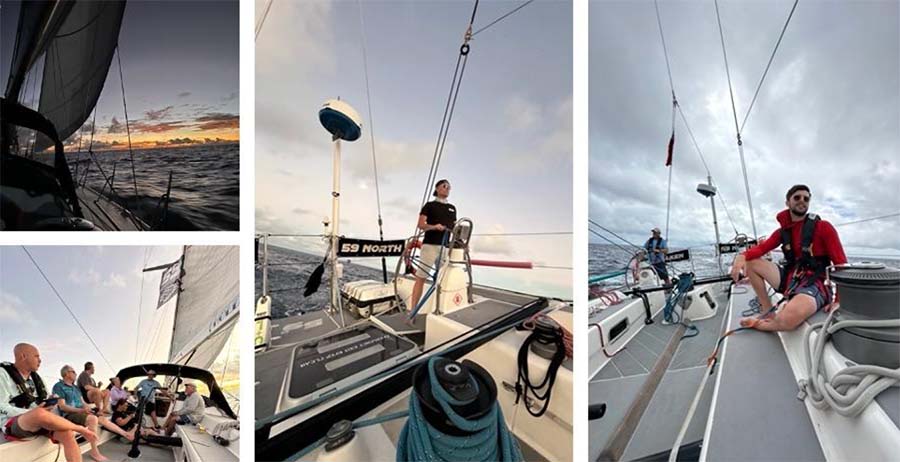
By Saturday April 12, 2025 (Shannon’s Birthday) Falken is averaging over 200 NM per day. That is fast! Even with this positive progress we are a bit down because Ted and Udo have come down with the cold. Scott, Kim and Ted have been named “Squall Team 6” because we have steered through a squall during every shift over the last eighteen hours. During our evening watch we endured driving rain (there is no cover on Falken, so you take it on the chin) and gusts of up to 25 knots. Our hands are starting to show signs of wear, with a set of calluses forming from holding the wet wheel.
At the time of this entry, the sun is shining, and we are drying wet clothes: three shorts, three pairs of underwear, socks, a neck gaiter, and two pairs of shoes. During and in between watches we get to know our crew mates and share stories to pass the time. Andy took the helm for a while during our watch. He talked a lot about how he met Mia and their journey together as a couple and the founding of the business. He was in a good mood but had a bit of a spill below. We are all tired.
– Kim (Crew)
Excerpt from Ships log: #6. FALKEN | GALAPAGOS TO MARQUESAS | RAIN
April 13, 2130 Ship’s Time | 6º45’S, 106º15’W | Second Reef in the Mainsail & Reefed Jib Top
The word association for this passage thus far would most definitely be rain. I had read a lot about the Intertropical Convergence Zone (ITCZ) prior to this trip as a former Pollywog who spends very little time near the equator. The meeting point between the NE and SE trades also commonly referred to as The Doldrums, known for its distinct lack of wind and unending rain. With the help of WRI, some satellite weather images, and our trusty GRIBs, we were able to very accurately predict the point at which the wind-deprived sector ended, as well as where the Southern Equatorial Current started to give us a push. The one thing that continues to perplex me is the sheer amount of rain we’ve faced along the way. Five plus times a day the boat (and therefore the crew) get a very thorough freshwater wash-down. One of the watches on board has deemed itself “Squall Team 6” due to the thousands of gallons of rain they’ve taken on the chin as we enter our seventh day.
At sea, it’s no surprise that some resources are usually conserved — this can mean electricity and data — but none of that here. Our radar is running almost 24/7 with a strategy that has shifted more from avoiding the storms to just knowing where they are when all you can see outside is the compass and faint glow of the masthead tricolor. The key to forecasting which showers hit us has been looking into the prevailing wind direction and paying attention to the weather about 15-30º to the left of the true wind, the obverse of my Northern Hemisphere brain. New GRIB files are downloaded when available, but I still can’t seem to explain how far-reaching this rain has been, or if and when we’ll be out of the majority of it.
The other thing with this rain is how the majority of it seems benign – just largely wet. As an East Coast US sailor, I’m no stranger to large pop-up thunderheads and downbursts of 40kts, but the vast majority of these storms have not been this. Only on a few occasions has the rain brought the cold, dense wind (and shifts) that I tend to associate with it.
In spite of all this, FALKEN achieved a 232nm run in 24 hours yesterday, averaging 9.66kts – and all of this was just with the poled-out Yankee foresail. The crew has absolutely been sending the boat — my glow for today was how everyone is driving like they stole it. Andy and I both predicted landfall on the 25th, and every day gets a little closer to that being a massive underestimate, not to jinx anything…
All in all, so far this has been an incredible navigational learning experience that I will never forget – or dry from.
~ Aidan Gray | 59º North Apprentice

Fantastic downwind sail, wing-on-wing, during our 9 PM to 12 midnight shift the evening of April 13th. The next morning Kim was in the process of reaching into a cabinet when Falken took a rogue wave to her port side. Kim couldn’t maintain her grip and fell, taking the impact on her left side and head.
Andy was there immediately on the scene to ensure Kim wasn’t knocked out. Asking questions: What’s your name? Where are you going? Why are you here? Emily (the ship’s medical officer) and Udo, a fellow crew member and physician from Germany, tended to Kim. After Udo’s exam to ensure nothing was broken, and there were no signs of concussion, Kim was put on bed rest with a cold pack to nurse her growing shiner.
The staff and crew were highly supportive, and teams were again shifted around to accommodate Kim’s injury. Fortunately, Jim was on the mend and able to steer, so Ted switched back to steer with Scott. It was fortunate that there was no major injury. We are in the middle of the Pacific Ocean over 1000 NM from land. There was no chance of making landfall if there was a grave accident.
We are so dependent on one another; if anyone is sick or injured, it puts more pressure on the remaining crew to pick up the slack.
~ Kim (Crew)


Leave a Reply