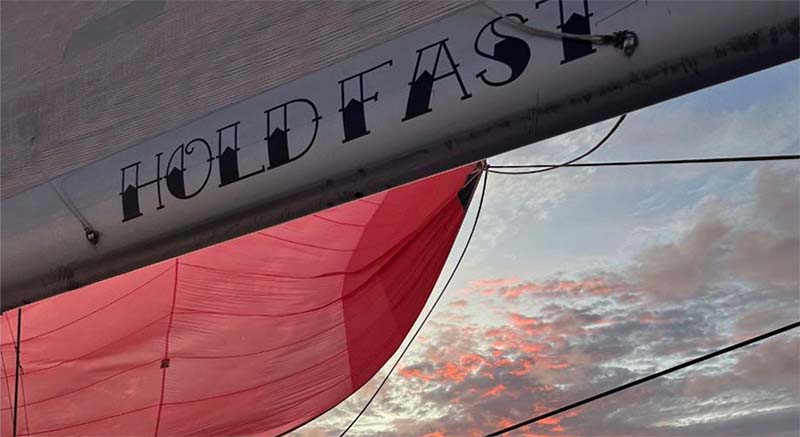
Excerpt from Ships log: #6. FALKEN | GALAPAGOS TO MARQUESAS | CELESTIAL
April 19, 2025, 2230 Ship’s Time | 8º48’S, 128º33’W | Full Mainsail & Poled Jib Top
“At certain times in the life of a navigator, it can be more useful for them to know not where [they] are, but where [they] are not.” — John Mellor, SAIL Magazine, November 1975
With Falken having happily found her stride and on the last 600-mile stretch to land, I found myself with some downtime to actually practice the one thing I set out to conquer on this passage— celestial navigation… I’ve really done my best to learn this dark art, but despite the hours of YouTube videos, online classes, and books, it’s maintained its ADHD-fueled mystery. I remember the first time Andy sat me down to explain the basics in Sweden last year using his signature “whatever fruit is available” presentation, and ever since it’s been my white whale. A geocentric model of the universe perplexes me, and I couldn’t get past the idea that celestial objects could be “above” something.
Well, with much patience and an open mind, we’re finally taking, reducing, and plotting sights— it’s starting to click. The last three days, the whole crew has taken turns getting in on the action, with Ted acting as a bit of a mentor for me. His approach is purely mathematical using spherical trigonometry and a ream of graph paper to boot. I’ve opted for the more classic Pub 249 and Nautical Almanac route (cosine who?), made a bit easier with some of the celnav worksheets Andy made available from the Quarterdeck.
The other thing that has been made abundantly clear is the need for a good structure of planned sights! This means making a plan and researching what stars might be easily available come twilight because there’s not much time to dilly-dally. Being right near the equator, it would look something like:
- AM Nautical Twilight Three-Body Fix (zenith and approx. altitudes pre-calculated)
- Running Solar Fixes around Local Apparent Noon – with one sight shortly before LAN, one near LAN, and one shortly after to account for the almost 180º azimuth change in this part of the world.
- PM Nautical Twilight Three-Body Fix (zenith and approx. altitudes pre-calculated)
Are we actually able to pull this off? Well…. Not yet. If you read Andy’s previous blog, it should come as no surprise that we’ve had some successful star sights. Alas, tonight I’ve been stumped for the past hour trying to figure out why Aldebaran was giving me a terrible intercept — after some heavy cheating, I’ve determined it was actually Jupiter. My white whale swims off into the starlit swell of the Pacific.
Here’s to hoping in these last few days, we can finally figure out where we are… Or aren’t.
— Aidan Gray
********************
Today is Saturday, April 19 and we have experienced the best 24 hours at sea. There are fewer than 800 miles from our destination, Hiva Oa, in the Marquesas. The seas have calmed to a gentle role and the winds have dropped to a steady 17 knots. It’s so easy to steer in this wind. You literally can use two fingers on the wheel to gently keep her on a course of 250 to 255. It’s a reminder of why we love being at sea and how comfortable life at sea can be.
Last night in the universe treated us to a light show of stars shining brightly in the sky. The familiar ones like the Big Dipper, Orion’s belt (consists of three bright stars: Alnitak, Alnilam, and Mintaka), but some new ones that we won’t typically see in the northern hemisphere. Polaris and the Southern Cross, for example. It was clear enough that some folks took sextant readings to calculate our position using celestial navigation.
The salt moon rose at about 11 o’clock shining like a beacon to the east, but not completely dimming out the stars to the west. We are not sure when we will ever see the sky like this again. So far from civilization that there’s no light pollution, there’s no air pollution either, making really clear skies. Combined with the lack of clouds the combination made for a perfect night. Our watch just went by effortlessly. Some of the crew playfully called Kim “Magellan” because she was so comfortable steering to the stars. Likewise, because the gentil breeze, we all slept really well and everyone woke in good moods today, except for poor Emily struggling with some stomach upset.
Today is shower day and there is talk that we may deploy the spinnaker later this afternoon. Everyone is up and we are cruising along at 9 to 10 knots. Effortless. As we draw closer to the Marquesas, the wind is expected to continue to die down. We have fuel in 2 of our 8 tanks which translates to a range of about 200 NM. It turns out we burned up most of our fuel heading north to the equator, then it was quite a way to get to the trade winds. In hindsight, maybe this decision was not prudent. We need to optimize our use of the wind over to next 800 miles. We are seeing birds, and on the lookout for whales. All is well.
Kim (Crew)
Excerpt from Ships log: #6. FALKEN | GALAPAGOS TO MARQUESAS | KITE
WRITTEN BY EMILY CARUSO
April 20, 2025, | Happy Easter Spinnaker
Another star filled sky as FALKEN continues to make good way towards the Marquesas. The kite is up which requires a very special level of consideration and Andy and Aidan are switching in to support the helm as I continue with the day-to-day chores. There is something magnificent about the night sky at this latitude and in such remote waters, Jim likened it to stepping into a planetarium, it really is very hard to describe.
With more room in our fridges at last, it seemed appropriate to chill a large bottle of drinking water ahead of dinner this evening and the crew response was highly entertaining. It would have been easy to imagine that they hadn’t ever experienced the luxury of a cool drink before as the ‘ooohs’ and ‘aaaahs’ resounded across the cockpit. Such a very simple, everyday concept that we take so very much for granted in the normal world, out here in the tropics proved to be an absolute delight, and one that we will repeat.
It’s interesting that after dark every evening we see an increase in the wind speed, and it is very much a trend that we have noticed. The spinnaker (kite) adds another layer of complexity to a night sail and FALKEN feels and sounds very different to me, as if she is running on adrenaline as opposed to her relaxed state from this morning, a feeling I see reflected in the crew. Nonetheless our speed is good, and we are still eating up the miles and under the watchful eyes of Andy and Aidan it seems like a good choice for our penultimate days at sea.
As much as I try to live in the moment, the opportunity to talk to loved ones is temptingly close and one that I am very much looking forward to when we make landfall. In the meantime, it’s back to the running of the boat and looking after the crew for me!
– Emily
April 21, 2025 (Monday) Crazy night, Pacific Ocean
Squall Team 6’s shift ended at 9 PM. We did not sleep during our daytime rest or during the night. The spinnaker could not be controlled, leading to loud bangs and pitching of Falken. Scott went on deck before the 3 am watch to help take down the spinnaker. When we gathered for the 3 AM watch, we could see that Udo, Jim, and Aidan were exhausted. They had worked extremely hard to keep the spinnaker full, pulling in sheets and easing, the only option was to steer off course. So, exhaustion on top of sailing in the wrong direction by about 70 miles.
During our watch, we had a hard time steering because of the light wind and swells. We put 2 reefs in the main to quiet it. Andy started the motor, and all hell broke loose when the smoke detector went off. We are making 5 knots of steering at 190 degrees. The 12 to 3 AM watch only made 20 miles in the wrong direction. We did not feel panicked at the smell of smoke, but did look at the life raft and think “what if?” After about an hour of alarms, Andy and the crew determined that the alternator belt was rubbing, causing the rubber on the belt to burn. This was likely due to poor service in Panama. Emily had a photo of what the setup looked like.
Andy and his dad worked on troubleshooting how to align the alternator belt. It was nice to observe how they worked together, and I think Dennis’s support helped Andy cope with this stressful situation. After about an hour, the engine was back on and charging.
This trip is dragging now for all, and everyone wants to get to land. Everyone is exhausted from the heat, humidity and lack of sleep. The passage is relentless and unending. Even though we are less than 500 miles from shore we are days away. The wind has died, and we are making under 5 knots off our course.
Our 12 PM to 3 PM watch we are making 6 knots with a velocity made good of about 5. The sun bore down on us, and we sought cover in the shade under the sail on our port side. We ate leftover tuna casserole in the cockpit. We have less than 340 NM to go at this pace; in another 2 days we may be within range to motor the rest of the way. We are all looking for whales, but there have been few wildlife sightings. Feeling content at the moment.
– Kim (Crew)


Leave a Reply